Wednesday, March 11, 2015

Face, an interesting and overlooked Japanese game publisher


Back in the 16-bit era there was a Japanese game publisher by the name of Face Co., Ltd.
There's very little information online about Face, and what information is out there tends to be buried under search results for a myriad of facially-related subjects.

What we do know about Face is that they were around from about 1988 to 2000, published games for an almost exclusively Japanese market, and tried their best to stand out from the crowd while simultaneously blending in.

So, why am I talking about Face?  Did they make an outstanding game?  Did they have a huge influence on the games industry?  Do they have an amazing back-story with ties to influential developers?

Well... no.

Face was merely a small Japanese game publisher who had a marginal-at-best impact on the games industry back in the day.  Generally speaking though, they made good games; a couple of which were only a few steps away from greatness... but they never did anything that was truly noteworthy.

What I like about Face is that even though they never made a really great game, they did make some pretty darn good games that were full of unique ideas and creativity.


According to my information, Face started publishing games in 1988.
Their first game was an arcade golf game, but after that they focussed on the home console market; mostly for the PC-Engine console, where they produced 10 games for the system over the course of 3 years, all in the Hu-Card format.
After their glory days on the PC-Engine, Face returned to the arcades where they struggled for a number of years before eventually fading away into obscurity.

During their existence, Face worked with several software houses, a few of which are still around to this day and have gone on to become successful companies. (I.T.L. & Arc System Works)

One of the things I really liked about Face was that they seemed to be willing to take some creative risks here and there, and in-turn produced a number of games that had a lot of quirky Japanese charm.

Of course, like many Japanese companies, Face's business model was focussed solely on the Japanese market, and due to this, only 3 of Face's games ever reached in the west:
  • Solitaire Poker (Gamegear)
  • Time Cruise (Turbografx 16)
  • Money Puzzle Exchanger (Neo Geo MVS)
As I mentioned, the majority of Face's games and the height of their business was on the PC-Engine. (Aka the Turbografx-16 in the west)
This is how I discovered Face - through their PC-Engine games, which range from decent to really good.


In the beginning...

Hany in the Sky 3/1/89
Face's first PC-Engine game was Hany in the Sky, which is where their company mascot Hany, aka Hani, Hanii, Haney, or Honey (depending on who's romanizing his name) comes from.

Hany is a haniwa figure, and as such, his name should probably be romanized as "Hani" or "Hanii", but the in-game romanization in Hany on the Road is "Hany", so we'll call him that.

Hany's name uses the same katakana as honey in Japanese, and in Hany on the Road, player 2 is named Lemon (Honey and Lemon, get it?).

Hany stars in 2 games: Hany in the Sky and Hany on the Road, and makes cameos in Mahjong Academy and in the intro of RYŪKYŪ.

*On 11/1/90, Polydor records released a soundtrack CD for Hany in the Sky and Hany on the Road titled "Hanii² - Sky & Road -".
**On 1/14/2009, SuperSweep Co. Ltd. released a new CD titled "Hanii in the Sky Soundtrack" featuring arranged versions of the music from Hany in the Sky.

So, was the game good or not?
Hany in the Sky is a cute vertically scrolling shooter with great music and a lot of unique ideas behind it.  The game is actually quite fun once you figure out that pausing the game and pressing I brings up the shop menu where you can trade your points for power-ups and extra health.  Hany in the Sky's one major flaw is in the controls, which only allows you to rotate hany's gun clockwise, making aiming a bit of a chore.  Like many of Face's games, with only a few small changes, this game could have been fantastic, but in the end was only few steps above mediocre.


Busō Keiji: Cyber Cross 6/23/89
Translation: Armed Police Cyber Cross
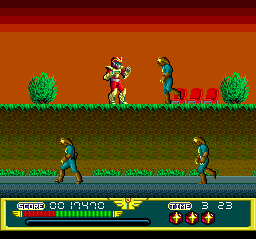
This game is inspired by Japanese Tokusatsu programs like Super Sentaii (Power Rangers).  The game is decent, sort of like Irem's Kung-Fu Master with more platform elements and power-up's.  The game has pretty good music, and the character's power-up/transformation animation is absolutely perfect. (You can practically hear your hero shout "Henshin!")
Overall, Cyber Cross is a decent game, but nothing worth writing home about.
*On 4/1/90, Polygram records released a soundtrack (both tape & cd) for this game that featured vocal, instrumental and karaoke versions of the Cyber Cross theme.


Mahjong Gakuen - Tōma Sōshirō Tōjō 11/23/89
Translation: Mahjong Academy Featuring Soshiro Toma
I can't really comment on this one, as I don't know how to play Mahjong, but it seems like a pretty good Mahjong game with several game modes and a password save system.  This game features a story mode that has girls stripping off layers of clothing as you beat them in Mahjong.  If you win enough rounds, you get to see some boobs.  This game seems to have been popular, as it's one of Face's most common games. 
*Apparantly, this game was available in a deluxe package that included a "mahjong drama" VHS that I can't seem to find much info about.  
**A soundtrack (both tape & cd) for this game was released by Polydor records on 4/1/90


Mahjong Gakuen Mild - Tōma Sōshirō Tōjō 6/29/90
This is basically just a re-release of the previous game, but with bikini's instead of full frontal nudity.


Hany on the Road 9/7/90
Hany on the Road is a really fun game that has a nice theme, original gameplay, cute graphics, catchy music, a simultaneous 2-player mode and a difficulty level that's too high for it's own good.  Had they toned down the difficulty a bit, perhaps by giving Hany's kick/flip attack a little more range or adding more checkpoints, this could have been an outstanding game.
This game had so much potential, but never quite reached the level of greatness.
*Fun Fact: you can sometimes find this game erroneously listed on eBay as "Honey on the Lord"


RYŪKYŪ 10/26/90
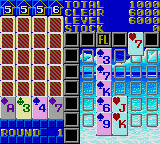
RYŪKYŪ was originally developed by the Ascii Corporation in 1989 for the MSX2, then ported to the arcades by Sega/Success in 1990, and was ported again to the PC-Engine by Face/Sankindo, and finally to the GameGear as RYŪKYŪ in Japan and as Solitaire Poker in the rest of the world.


RYŪKYŪ is a variation on the solitaire game known as "Poker Squares" or "Poker Solitaire", and get's it's name from the tropical Ryukyu islands off the coast of Japan.


In RYŪKYŪ, Instead of being able to place cards in any space as in Poker Squares, the cards will drop  down and rest atop any other cards below them.  The game also includes a "joker" that acts like a wild-card, which can be placed strategically to increase your score.


RYŪKYŪ contains several game variations that include difficulty settings and time limits, and when you score enough points to win, a drawing of a bikini girl (or parts of it) will be revealed.
If you like games that have you thinking strategically, like Free Cell, you will find yourself addicted to this game.


Fushigi no Yume no Alice 12/7/90
Translation: Alice in Wonderdream
Alice is a really cute game that could have been an all-time classic if it wasn't so damn hard.
There's really not much else to say about this game.  It's good, but far from great.

*This game was previewed in the instruction manual for Cyber Cross, which means that unless they finished the game and delayed it's release, then Alice had at least a year and a half of development time!
**On 12/21/90 Polydor records released a soundtrack cd for this game featuring arranged music.


Cross Wiber - Cyber Combat Police 12/21/90
This is the sequel to Cyber Cross.
This game was made by a different developer, and it shows.  Overall, Cross Wiber looks and plays similarly to Cyber Cross, but with a few changes:
  1. The graphics are nicer
  2. Your character has more attack moves (crouch kick, jump kick, and a roundhouse kick that uses up one of your health points)
  3. There are a few side-scrolling shooter stages.
  4. The game is entirely in English
  5. You can only transform when your health bar is nearly full (blue) by pressing Select.
  6. The transformation sequence isn't as good as in Cyber Cross, and your hero looks more like a mech than a "Power Ranger".
  7. The game is slightly easier (except for the stages where you're constantly getting knocked into bottomless pits), and gives you continues.
Overall, the game is of a higher quality than Cyber Cross, but lacks much of it's charm.


Metal Stoker - Neo Hardboiled Shooting 7/12/91
Metal Stoker is an overhead shooter that has you controlling a tank that can acquire a variety of weapons and shoot in any direction.  This game is pretty fun and has a good deal of variety, but I wish the controls would have let you hold button 2 to lock your firing direction and release it to unlock your firing direction, instead of the awkward "Press button 2 to lock your firing direction, and press button 2 again to unlock the firing direction".
This is another example of Face coming close to creating a hit game, but somehow narrowly missing the mark.


Time Cruise II 11/8/91
Oddly enough, this is the sequel to a game that was never released.  The original Time Cruise was previewed in Gekkan Pc Engine Magazine in February 1990 and clearly showed a different game.  How come only the sequel came out?  Note: Time Cruise II was released in the US under the name Time Cruise for obvious reasons.


Anyway, Time Cruise II is a pretty good time-travel themed pinball game with some interesting ideas and features.  It may not be the absolute best pinball game on the PC-Engine, but you can pick this game up for a lot less than Devil Crash and have almost as much fun with it.


Famicom:

Chiyonofuji no Ooichou 12/7/90
Translation: Grand Sumo Champion Chiyonofuji
As far as sumo wrestling games go, this one's pretty good.


Game Gear:

RYŪKYŪ 5/31/91
Released in the west as "Solitaire Poker"  This is a slightly watered-down port of the PC-Engine version that lacks the girly pictures.


Arcade:

Albatross 1988
I believe this was a golf game.  If my info is correct, this would have been Face's first game.

Quiz DNA No Hanran 1992
An arcade quiz game.


Quiz Gekiretsu Scramble 1992
An arcade quiz game.


Sand Scorpion - Sasori 1992
Overhead shooter.

Nostradamus 1993
Overhead shooter.

Digger Man 1994 (Neo Geo MVS) 
Unreleased.  Digger Man is a port of Game Room's "Dangerous Dungeons" (1992)

Gururin 5/25/1994 (Neo Geo MVS)
A puzzle game that has you rotating the playfield instead of the falling pieces.

Money Idol Exchanger 1/17/1997 (Neo Geo MVS) Released in the west as Money Puzzle Exchanger and Ported to Gameboy and PS1 in Japan by Athena Co. Ltd. the same year
*There are rumors that Data East sued Face over the similarities between this game and their popular Magical Drop series.  Supposedly, Face lost the law suit, and went bankrupt because of this.


PC:

Hoshi no Furu Sato (stardust memories) 7/28/2000
As far as I can tell, this was Face's last game.  It's described as an adventure game, but there seems to be no other information about it.


In the end, Face managed to survive for just over a decade as a game publisher.  They jumped into the games industry at the height of the Famicom/PC-Engine era expecting to make a fortune, and even though they had little to no experience making/publishing games, they gave it their all.

Their Pc-Engine games may not have been masterpieces, but they were good games, and (for the most part) had great instruction manuals.  The Hany in the Sky, Cyber Cross, Mahjong Gakuen and Mahjong Gakuen Mild manuals were presented in a magazine format called "Face Press" and had lots of hand-drawn artwork, tips and interviews.
Face even had a fan club called "Face Scramble Club" that gave you opportunities to get prizes like Cooler-Bags, Matchbook-Calculators, Stickers and Videos.  You could even become a game tester through the Scramble Club!

Though, once the Hu-Card era wound down and production switched to CD based games, Face bowed out of the PC-Engine market and focussed on the arcades. As time went on, they began releasing fewer and fewer games, then eventually disappeared.

It seems that Face didn't quite have what it takes to be a successful game publisher, but had they run their business a little differently and polished a few of their games a bit more, they might have still been around today.


In conclusion...


Face tried their best to rock the game's industry back in the day, but just couldn't compete with the visionaries behind Nintendo, Taito, Sega, Konami, Capcom, Irem, etc.
Had they more resources at their command, maybe they could have turned Hany into a successful franchise, ported their games to more consoles, and have been more than just a footnote in the PC-Engine's library.

Here's a timeline of Face's games, and the developers involved in making those games:

Albatross (Arcade) 1988 - Developer: ?
Hany in the Sky (PC-Engine) 3/1/1989 - Developer(s): Sankindo, Arc System Works
Cyber Cross (PC-Engine) 6/23/1989 - Developer(s): I.T.L. (Imaginative Technology Land)
Mahjong Gakuen (PC-Engine) 11/23/1989 - Developer(s): Sankindo, Arc System Works
Mahjong Gakuen Mild (PC-Engine) 6/29/1990 - Developer(s): Sankindo, Arc System Works
Hany on the Road (PC-Engine) 9/7/1990 - Developer(s): Arc System Works
RYŪKYŪ (PC-Engine) 10/26/1990 - Developer(s): Sankindo
Alice in Wonderdream (PC-Engine) 12/7/1990 - Developer(s): Sankindo, Arc System Works
Chiyonofuji no Ooichou (Famicom) 12/7/1990 - Developer(s): Arc System Works
Cross Wiber (PC-Engine) 12/21/1990 - Developer(s): Sankindo, Arc System Works
RYŪKYŪ (Game Gear) 5/31/1991 - Developer(s): Sankindo
Metal Stoker (PC-Engine) 7/12/91 - Developer(s): Sankindo
Time Cruise II (PC-Engine) 11/8/91 - Developer(s): Sankindo
Quiz DNA No Hanran (Arcade) 1992 - Developer(s): Sankindo
Quiz Gekiretsu Scramble (Arcade) 1992 - Developer(s): Sankindo
Sand Scorpion - Sasori (Arcade) 1992 - Developer(s): Sankindo
Nostradamus (Arcade) 1993 - Developer(s): Sankindo
Digger Man (Arcade) 1994 - Developer(s): Minato Giken
Gururin (Arcade) 5/25/1994 - Developer(s): Minato Giken
Money Idol Exchanger (Arcade) 1/17/1997 - Developer(s): Minato Giken
Hoshi no Furu Sato (PC) 7/28/2000 - Developer(s): ?

If this blog has you interested in Face's games or PC Engine games in general, here's a few tips to help you find what you're looking for:
  • eBay and Amazon are good places to find PC Engine games, and if you're lucky, you can find a game lot on eBay with pictures but none of the titles listed.  You can always check pcengine.co.uk to figure out what the games are, and you may end up getting a good deal due to fewer bidders finding that auction.
  • Another good place to find PC-Engine games is JapanGameStock.com.  You need to be willing to buy multiple games to make the shipping cost effective, but their prices and selection are quite good.
  • When hunting for PC Engine games online, you should try searching for "pc-engine", "hu-card" or "PCエンジン".  Though, the latter will give you a lot of results in Japanese.
  • You can often find better prices if you buy in bulk from Japanese auction sites like Yahoo Auctions, but you will need to use a bidding proxy service such as Rinkya or Celga to do so.
Thanks go out to the following websites for helping me to research the Face company:

Pcengine.co.uk
Gdri.smspower.org
Gamesdbase.com
Arcade-museum.com
Gamefaqs.com

Saturday, October 18, 2014

Dig Dug Vs. Mr. Do! - Which is a better game?


Among classic gamers, there are few subjects more controversial than Dig Dug Vs. Mr. Do!.
Online polls show that gamers are strongly divided over which of these two is the better game, with Dig Dug fans saying that theirs is the better of the two and that Mr. Do! is just a rip-off, where as Mr. Do! fans praise their game's extra depth and variety.

Today I'm going to try to settle this debate once and for all from the perspective of both a classic gamer and game designer.


For those of you who are unfamiliar with one or both of these games, Dug Dug and Mr. Do! are both vertically oriented arcade games from 1982 that have a similar game mechanic of digging through the play field and making tunnels. Dig Dug was developed by Namco, famous for previous successes like Pac-Man and Galaga, where as Mr. Do! was developed by Universal, who had some moderate successes with previous games like Space Panic and LadyBug.

Dig Dug is a game about a man in a protective suit who digs through the earth in an attempt to rid screen after screen of Pooka and Fygar monsters.
The player is armed with an air pump who's hose can shoot out several feet and stick into the enemies.  Using this pump, you can inflate your enemies until they explode.  There are also rocks which you can dig underneath of and drop on your enemies (or yourself), and after dropping 2 rocks, an item appears in the center of the screen which you can collect for bonus points.
Occasionally, the enemies will go into "ghost mode" and float towards the player until they intersect a tunnel.
When only one enemy remains, it will try to run away, which forces the player to give chase, or else lose out on the chance for some extra points.
Each round is basically the same, except for some slight changes to the color of the earth, increased number of enemies and increased speed.
The game also includes a continue feature that lets you start the game at the last stage you were on, but with your score reset to zero.

As for Mr. Do!: in this game, you play as a clown who digs through the playfield in the exact same fashion as Dig Dug, but you can finish the round in one of 4 different ways: collect all the cherries, kill all the enemies, Kill all the "Alpha Monsters" to spell EXTRA, or collect the rare diamond that awards a free game.  Instead of an air pump, Mr. Do! is armed with a ball that can be thrown and will bounce through the tunnels until it hits and destroys an enemy.  When a ball destroys an enemy, it disappears for a few seconds before reappearing back in Mr. Do!'s hands.
There are apples in the playfield that can be dropped just like the rocks in Dig Dug, but unlike those rocks, Mr. Do!'s apples can also be pushed.  On rare occasions, a diamond will appear after dropping an apple.
The enemies in this game are Dinosaurs, who appear one by one from the center of the screen. Once all the dinosaurs have entered the screen, the bonus item will appear.  Collecting this item will freeze all dinosaurs in their tracks, and 4 Munchers will appear followed by an Alpha Monster (Alpha monsters also appear every 5000 points).  Destroying the Alpha monster will net you a letter, and all remaining Munchers will turn into apples.
Dinosaurs will occasionally transform temporarily into a "digger" who will tunnel through the earth in an attempt to reach Mr. Do!
Each stage of Mr. Do! is shaped like a number, except for stage 1 which is shaped like a D, and as the stages progress, the enemies become faster and faster.


So, which of these two games came first, and was one of them a rip-off of the other?

Well, according to the Japanese release dates, Dig Dug came first in April 1982 followed 6 months later by Mr. Do! in October 1982.
With 6 months between the two games, it's quite possible that Mr. Do! was inspired by Dig Dug.  Adding to this theory is an unconfirmed report that Dig Dug was shown to the public at trade expos some time in 1981, which if seen by Universal at that time, would have certainly allowed them plenty of time for them to "rip-off" Dig Dug.

For Universal, Cloning other companies games certainly isn't without precedent.  In their earlier days, most of Universal's games were clones of other popular games.  For Example, 1979's Cosmic Monsters was an obvious clone of Space Invaders.
Though, as time went on, Universal's games became more and more original, but still tended to show influence from other games of the time. One example of this would be 1981's Lady Bug, which shows strong design influences from Pac-Man, yet manages to be a completely original game.

In the case of Mr. Do!, the game design shows clear influence from Dig Dig, but changes the game around quite a bit while attempting to improve upon it in several ways.

Regardless of who came first, it's time to decide once and for all, which of these two arcade classics is a better game.

The Battle!

Round 1: Graphics and Presentation (this round is worth 2 points)

The graphics for Dig Dug are quite good: the game has a nice title screen, excellent sprites, and pretty good colors for a game that's mostly dirt and rocks.
Mr. Do! also has a nice title screen, but Dig Dug's title screen wins out with it's large renditions of the in-game characters.
For in-game graphics though, Mr. Do! is definitely the more colorful of the two.  The enemy sprites aren't quite as good as Dig Dug's, but Mr. Do! has more variety: colorful apples, nicer looking bonus items, more enemy types, the dazzling starburst effect when you kill an enemy, and the cutscenes.
It's hard to decide a winner in this category, and I'd like to give the point to Mr. Do! for all it's extras, but the dinosaur sprites barely look like dinosaurs and the cutscene art could have been drawn better.
Round 1 winner - Tie. 1 point for Dig Dug, 1 point for Mr. Do!

Round 2: Sound  (this round is worth 3 points)

In Mr. Do!, you have a pleasant coin-up sound, a short musical intro which is followed by a fun rendition of the can-can that plays throughout the stage.  When the Alpha Monsters and Munchers are chasing after you, the music changes to a cute, but intense loop, and upon finishing the stage, you get a short musical outro.  
The cutscene that plays every 3 stages has a simple little tune, and when you get an extra life, you are treated to a quick rendition of the Astro Boy theme song.  The sound effects in Mr. Do! are great, with an excellent apple falling sound, a magical destroy enemy/ball re-appearing sound, and  the ball bouncing and apples hitting the ground sfx are quite good as well.
Overall, Mr. Do!'s sounds and music are well done and provide an enjoyable atmosphere for the game.
As for Dig Dug, it too has good sound: a cute coin-up sound, a nice musical intro and outro for each stage, and a fun in-game tune.  One major difference is that while Mr. Do! constantly plays it's music, Dug Dug only plays music while you are digging.  This gives the game an original quality of it's own, and although different, seems to work well.
Also, when the last enemy is trying to escape, the music speeds up to add to the tension/excitement.  The game has a nice high-score tune as well, but for sound effects, Dig Dug only seems to have very basic sounds, although they suit the game just fine.
Both games sound good, but Mr. Do! sounds better over all, and when you compare the two side-by-side, Dig Dug's sounds and music are more "tinny", and Mr. Do! has a greater variety of sounds in general.
Round 2 winner - Mr. Do!  1 point for Dig Dug, 2 points for Mr. Do!

Round 3: Gameplay (this round is worth 5 points)
  • Variety.   Dig Dug has little variety to it's gameplay: 2 fairly similar enemies, dirt, rocks, and a bonus item.  Mr. Do! on the other hand has a lot more variety: 4 ways to end the round, cutscenes, Alpha monsters, pushable apples, and a unique design for each stage.  The point goes to Mr. Do!
  • Replayability.  Both Dig Dug and Mr. Do! have a good deal of replayability.  Dig Dug is always challenging you to get a higher score, and taunts you every time you get a game over with it's continue function that makes you want to see what the next round has in store for you. Unfortunately though, all the next round has is more or faster enemies and an extra flower at the top of the screen.  Mr. Do! beats out Dig Dug in this category with it's Alpha monster system of earning extra lives and the lure of winning a free game by finding the diamond.  Both Dig Dug and Mr. Do! are designed so that the player needs to develop a strategy to progress far in the game, but Mr. Do!'s extra gameplay mechanics give a seasoned player more to keep them entertained.  The point goes to Mr. Do!
  • Excitement.  Both games are exciting, but Mr. Do! is just so much more exciting.  Dig Dug's excitement mostly stems from being swarmed by enemies and trying to stay alive.  Dig Dug is almost purely a game of quick reflexes mixed with simple strategies.  Mr. Do! on the other hand, while also a game that requires quick reflexes and simple strategies, ramps up the excitement in many ways.  For example, Mr. Do!'s ball:  The more you attack with your ball, the longer it takes to return.  While the ball is gone, you have to run from the monsters and focus on using the apples to your advantage; this adds an element of fear to the game which increases the excitement.  Also, the dinosaur enemies can push apples and sometimes drop them on you, which also adds to the excitement.  But what really makes the game exciting are the alpha monsters and diamonds.  When the Alpha monsters come out, the munchers come out too, and they're quick, meaning that you need to be alert to get your letter.  On the rare instance when a diamond appears, you have to try to grab it quick while trying not to get killed by the monsters.  all of this makes for very exciting gameplay.  The point goes to Mr. Do!
  • Game feel. These 2 games have a similar feel to them.  For digging through the dirt, both games behave exactly the same.  One plus that Mr. Do! has is the ability to push the apples, and one plus that Dig Dug has is that he's quicker to attack, making it easier to turn around and hit an enemy that's chasing you.  This is essentially a tie.  One point each.

Round 3 winner: Mr. Do!  1 point for Dig Dug, 4 points for Mr. Do!

Round 4: Appeal  (this round is worth 3 points)

Mr. Do! is a colorful, fanciful game with an appealing protagonist (unless you don't like clowns) and a great deal of variety.  
Dig Dug on the other hand is a little less colorful, and a bit simpler of a game. This simplicity works well in Dig Dug's favor, as there is virtually no learning curve.  
You have a game screen that you can dig through, enemies to get rid of and a weapon that is both amusing and effective.  You can immediately understand the game mechanics, the characters and the concept of the game by just looking at the marquee or title screen, and that goes a long way when trying to get people to drop a quarter into the machine.
Round 4 winner: Dig Dug.  2 points for Dig Dug, 1 points for Mr. Do!

Final score: Dig Dug: 5 , Mr. Do!: 8

When you carefully dissect these two games, it becomes apparent that Mr. Do! is the better game.  Even so, there is a massive fan base for Dig Dug that will always defend it as the better game.  Why is this?

As far as I can tell, Dig Dug's popularity stems from 2 factors: Simplicity and Name Recognition.  While some players strongly prefer Dig Dig's simplicity, others seem to choose this game because they're more familiar with it.

Consider this:

Dig Dug was developed by Namco, a company who was well known and well respected back in 1982 and is still respected as a great game developer even to this day.

Namco regularly publishes "Namco Museum" collections of their classic arcade games, which typically include Dig Dug.  By continually re-releasing the game, it continues to stay in the public's consciousness.  

Dig Dug was originally published and distributed in the U.S. by Atari; a huge, well known and well respected company who's name was synonymous with video games back in the day.

Atari also secured the rights to port Dig Dug to the majority of game consoles and home computers back in the day.

The game's characters are prominently featured on the title screen, marquee, flyer and side art.  This makes the game instantly recognisable and incredibly memorable.

Because of all this, more people have been exposed to Dig Dug than to Mr. Do!.
Greater exposure leads to more fans, and more fans leads to more people who prefer the inferior game.

So there you have it,  Mr. Do! bests Dig Dug in many ways, but loses a lot of potential fans due to Dig Dug's superior marketing and distribution.

This brings up a good topic:
Marketing and appeal are incredibly important things to consider when making a game.
Often, developers/designers are only concerned with gameplay and deadlines, and it's usually up to the art or marketing department to make sure the game has adequate appeal, but when designing a game, you should keep this in mind as well.

I'm sure you've seen it time and time again, a game comes out that isn't any better than another, but ends up becoming vastly more popular.
For example:
Bejeweled Vs. Candy Crush: candy has a little more appeal than jewels, add in an aggressive marketing campaign, and the game makes a fortune.
Crush the Castle Vs. Angry Birds: Crush the Castle came first, but the character appeal of the birds made the game a global phenomenon.
This is why is Hello Kitty a billion dollar industry: character appeal and marketing go a long way.

I believe that if Mr. Do! had an excellently drawn clown on the marquee, the title screen and the game flyer, it would have been a much more successful game.

So keep that in mind if you are designing a game, it doesn't matter how good your game is; a weak presentation will impact your sales.

Trivia:

Dig Dug wasn't the first arcade game to feature a player who digs through the earth, that honor goes to 1981's The Adventures of Robby Roto by Bally/Midway.

Dig Dug contains a hidden copyright notice that is accessed by entering the service mode, holding down the player 1 fire button and pressing Up 6 times, Right 3 times, Down 4 times and Left 8 times.

Dig Dug's hero was named "Dig Dug" up until it was revealed that his name is Taizo Hori, and he is the father of Susumu Hori AKA Mr. Driller.

In Mr. Do.! , if you dig out the dirt from around all sides of a cherry, it turns into a rose.


In the prototype of Mr. Do!, Mr. Do! was a snowman with a rake.


Also in the prototype, Mr. Do!'s head swells up and bursts when he dies. This might indicate that Mr. Do! initially started out as a Dig Dug clone, seeing as this death sequence makes a lot more sense if it were in a game about inflating your enemies to death.

And finally, the Mr. Do! character is based on the company logo/mascot that Universal used in the 1970's.
Here's a detail from the 1977 arcade flyer for B-29 / Scratch

Saturday, October 11, 2014

Hard Hat: an exercise in game design (part 3)

Hardhat part 3 - porting the game


Before we can update or improve the game, we must first recreate the basic functionality of the arcade game.
This would be a little easier if we had access to the game's source code, but without it, we need to carefully observe the game in action to figure out the proper timing and behavior of everything.
Fortunately, the game is relatively simple, but even so, I may miss some of the subtler aspects of the gameplay while porting it over.
One tool that we have to help with this port is Mame.  Pausing the emulation in Mame and using the "frame advance" function (Shift + P) allows us to accurately measure timing, this will help greatly to figure things out.

I'll spare you the details of the porting process, but in short, I started by replicating the player movement and screen scrolling functionality, then added in the letters and enemies.

My port isn't 100% accurate, but it's close enough.
A few differences between my version and the original:
  1. You can walk over the letters when they have been put in place.  I did this because in the original, the letters created a huge impassible wall that only added frustration to the game.
      
  2. The tornado is very close, but not exactly like the arcade version.  It's hard to figure out exactly how something works just by observing it, but I came close.  The arcade version seems to have a subtle amount of deviation from it's path that I didn't replicate, and also didn't get the tornado's starting point exactly like in the arcade version, but again, I'm pretty close.
      
  3.  My hammers are larger than in the arcade version, their starting point isn't exactly like in the arcade version, and they randomly travel 24 pixels instead of 8 pixels like in the original.  Overall though, they're close enough for our purposes, as we won't be using the original arcade movement when we're done.
Hard Hat's scoring is kind of interesting:
  • Removing a post = 50 points
  •  Destroying a hammer with a letter = 10 points + 10 points for every hammer previously destroyed
  •  Finishing the round = 8000 points (why not an even 10,000?)
  •  Pushing a letter into the correct spot = 900 points (why not an even 1000?)
Also, there seems to be a scoring bug in the arcade game, as putting a letter into the correct spot by scrolling the screen gives you no points at all.
 
Anyway, I programmed this port of the game with ClickTeam Fusion.
I use Fusion for all of my development, as it is an excellent tool that's really easy to use.
 
Clickteam Fusion is a tool for developing games and applications for PC, but it has optional exporter modules for a wide range of systems such as iOS, Android, Flash and html5 to name a few.
For this game, I used the Flash exporter so you could try my game in my blog post.
 
If you're interested in trying out Clickteam Fusion, they offer a free trial version Here

Anyway, here's my current work in progress version of Hard Hat that currently serves as a port of the arcade game.
It might have a bug or 2 that I haven't found yet, but it seems to work pretty well.  If you encounter a bug, hit the Esc. key on your keyboard to restart the game.


Next time, I'll share with you a version of the game with my improvements added.

To be continued...

Friday, October 10, 2014

Hard Hat: an exercise in game design (part 2)

So, continuing with our experiment to see if the mediocre arcade game Hard Hat can be improved, we must first start by recreating the game.

Instead of recreating the arcade game exactly, I'm going to approach this experiment as though I were doing a port of Hard Hat for either the Colecovision, Sg-1000, MSX, or Ti-99/4a  home computer.  More precisely, I'm going to convert the graphics so that they are compatible with the TMS9918a video chip.
Here are some color bars from a TMS9918a video chip

I'm very familiar with the TMS9918a video chip's specifications, and it was a pretty common video chip in 1982, so if Hard Hat was going to be ported to a console or home computer in the early 80's, the port would have likely used this video chip.

The TMS9918a  produces a display of 256x192 pixels and uses a 16 color pallette.  This chip can display 4 16x16 single color sprites per row, and can display 2 colors per 8x8 background tile.  Special display modes can display more colors per background tile, but are still limited to 2 colors for every 8 horizontal pixels.

This chip is similar to the hardware of the arcade game, but not exactly the same.  So, when converting Hard Hat to the TMS9918a's specifications, a few changes need to be made.
The biggest change is the game's vertical resolution.  The arcade game has a higher vertical resolution than our target specs, so to make everything fit on-screen, we will need to remove one of the rows from the playfield.
This change affects the accuracy of the port a little, but doesn't really impact gameplay.  Though, one benefit of this change is that the word in the center of the screen is now more centered.

The sprites will all need to be single colored.  The player and the tornado are already a single color, but the hammers and the letters will need to have their colors reduced.
A few background tiles need to be redrawn a bit, but overall, the look of the arcade game can be reproduced with a good deal of accuracy.

Arcade original (left) and TMS9918a version (right)

As a self-professed pixel wizard I always feel the need to improve things a bit, so why just stop at converting the arcade graphics, why not take it a step further?  The arcade hardware can only produce 8 very basic colors, so let's take advantage of the TMS9918a's 16 color palette and pretty it up a bit.

The game has a construction theme, so let's make the walls into wooden boards, give the scaffolding a more natural grey, and make the connecting pieces look more like scaffolding connectors.


For the sprites, the player can be re-drawn to look a bit more like an actual hardhat with legs, and the animations can be improved a bit too.
The arcade tornado uses way more frames than necesary, so it can be redrawn to use fewer frames and look a little nicer.


So, now with the graphics converted and improved, we can move on to the next step of our experiment: programming the Hard Hat port.

To be continued...

Tuesday, October 7, 2014

Hard Hat: an exercise in game design (part 1)


Who doesn't love arcade games?
They're easy to pick up and play, full of action and excitement, and they're great for when you've only got a few minutes to spend playing.

Now, I could easily talk to you about a classic arcade game that has aged really well and tell you all the reasons why it's a great game, but instead I'm going to discuss a game that was never popular, Exidy's Hard Hat.


Why would I discuss an obscure, mediocre arcade game?  Well, I believe that we can often learn more from failures than successes, and I believe that Hard Hat had some interesting and original ideas behind it that would be fun to explore.

So, what is Hardhat?
Hardhat is an arcade game that was programmed in 1982 by Larry W. Hutcherson Sr. and published by Exidy.
On the arcade flyer, Hard Hat is billed as the "First educational coin-op game" and described as "a unique logic game with an educational puzzle to solve".
By modern standards though, Hard Hat is more of an action/puzzle game with a stronger focus on action than puzzle.
In Hardhat you play as a handyman, represented by a hardhat with legs, who runs around removing pieces of scaffolding that fill the screen. When the scaffolding is removed from one side of the screen, everything slides over one space, and new scaffolding comes in from the other side. Along with the scaffolding, there are occasional sections of wall that cannot be removed and must be navigated around. The goal of the game is to position letters atop the word in the center of the screen. For example, the first stage's word is Exidy and you must position the E,X,I,D and Y into the correct spots. Letters will slide onto the screen along with the new scaffolding. You can position letters either by pushing them, or by sliding the scaffolding over by removing it from one side of the screen. When all letters are in place, you receive bonus points and move onto the next stage.

To provide challenge are the enemies: hammers which roam around the screen at random, and tornadoes,which target the player's position at the time the tornado appears. Both tornadoes and hammers will kill the player if they collide with him, but tornadoes will also remove walls and randomly reposition any letters that come into contact with it. The only way to get rid of enemies is to scroll them off screen or by pushing a letter into them, which isn't all that easy to do.

By itself, Hardhat is an OK game, but the random movement of the hammers combined with the awkwardness of needing to position letters by using the screen sliding mechanic keep it from warranting much replay.

What I want to do with this game is to make a few minor changes to it in an attempt to make it more fun.

So, what exactly can we do with this game?

The ultimate goal would be to keep the game's same basic mechanics: joystick only control, removing pieces of scaffolding to shift the playfield around, placing letters and avoiding enemies, but somehow make the game more enjoyable. To do this, we need to address the game's flaws.  Let's start with the enemies.


The tornado seems to work pretty well: it keeps the player from staying in one spot too long, it redefines the maze/screen, and it can foil your efforts to place the letters in the correct spot. Since this works well, let's instead focus on the hammers. The hammers are random and can go anywhere except through walls and letters. The randomness makes it hard to predict where they will go, and instead of making it exciting, makes for uninteresting gameplay. To make the hammers more interesting, we need to give them better AI. With better AI, 2 things happen: First, the player's objective becomes more defined - run away from the hammers, because they're out to get you. Second, the game gets much harder.

We can balance out the difficulty by making the AI more complex than just having it make a bee-line towards the player. As the player removes pieces of scaffolding, he creates paths or open areas on the screen. If the hammers chase the player through the paths, but also have a little randomness: reversing direction, targeting a different direction, wandering, etc., then we can balance out the difficulty a little.

The other major flaw that I see with this game is that there's no real way to deal with the enemies other than to avoid them. Avoiding enemies all the time may be challenging, but isn't all that much fun. To remedy this, we need some kind of attack.

Taking a cue from the timeless classic Pac-Man, we can add temporary power-up's.
Keeping with the construction theme, we can use a buzz-saw as our power-up.

Buzz-saw icons can occasionally slide in along with the new scaffolding. When the player collects one of these icons, he can turn into a spinning buzz-saw blade temporarily. In this state, the player can move more quickly, destroy walls, and will kill any hammers he collides with.


With these 2 changes, the game should become more dynamic and interesting to play while still retaining the same basic gameplay mechanics that it was designed around.
That's the theory anyway.
To prove that this game can go from mediocre to rockstar with just a few changes, I'll need to start by recreating the original game, then adding the new features and changes.
I'll be building this game in Clickteam Fusion 2.5, and will share with you my work in-progress step by step.

Before I conclude this blog entry, I'd like to share one more thing with you:


These are the original arcade graphics that you can view in Mame.  Looking at these, you might notice a couple things:


First, the tornado uses an amazingly long 16 frame animation loop, but the player only uses 4 frames of animation for the walk cycles.

Second, it appears that the game has unused animations of the player being squished.

This is interesting, because it means that sometime during production of this game, the player must have been able to be squished by the walls.
This was obviously removed due to the extra difficulty it would have added to the game, seeing that without that feature, it's already a challenge just to pass the first round without practice.

To be continued...

Saturday, October 4, 2014

Ba-Bomb!: Lessons learned (part 6) Final thoughts


Ba-Bomb! was a huge learning experience for me.
It was my first time making a sequel, and I enjoyed the time I spent making the game, but the game's lack of success is a bit of a sad spot for me.

I must admit that I approached this project with a rather naive attitude, both expecting to achieve success by creating a good game, and assuming that my game design was not without it's flaws.

So what did I learn?

I learned that for a casual game to be a hit, it needs:

  1. To have a "pick up and play" quality to the game.  If your 70 year old Grandmother can't figure out the game in 10 seconds, then you need to go back to the drawing board.  I came fairly close with Bombin'/Ba-Bomb!, but not close enough.  The game is deceptively strategic and logical, and even though anyone can start playing the game without reading the instructions, they may miss some of the finer points, such as paying attention to their remaining matches.  
  2. Mass appeal through pretty graphics and a likable game setting.  Even though Pengi adds cuteness and general appeal to the game, it seems that bombs don't appeal to women.  Women are the #1 market for casual games, and thus Ba-Bomb! doesn't have mass appeal.
  3. A multi-thousand dollar advertising campaign, or brilliant guerrilla marketing campaign.  I am not a marketing genius, nor did I have much of an advertising budget.  If I had it all to do over again, I would have spent what little advertising budget I had on something like Google Adwords or Facebook ads instead.
I also learned many new things about game design.  This was my first large independent project, and I got a good grasp on exactly how much work goes into making a polished puzzle game with multiple modes and features.  I learned how to simplify and streamline production by reducing assets and features while still providing a satisfying core gameplay experience.
I learned about advertising, code optimization and how graphics alone can impact gameplay.
I learned about balancing stats for an RPG, and making sure the difficulty ramp-up is fair.

I'm sure there were many other things I learned during the production of Bombin' and Ba-Bomb!, but they slip my mind at the moment.

So, in conclusion, is Ba-Bomb! a perfect game?
Definitely not.

Is it a bad game?  By no means could Ba-Bomb! be considered a bad game.

So what is it, then?
Ba-Bomb! is a game that succeeds in many ways, and almost but not quite succeeds in others.
It's a casual puzzle game that certainly has it's fans, though few may they be, but misses a few key marks that could have brought it success.

Personally, I love Ba-Bomb!, but I can't really be objective as I was the one who made it.

If you are looking for a fun, casual yet imperfect game, why not give Ba-Bomb! a try?

-Links-
Bombin': http://studiopinagames.com/bombin.html
Ba-Bomb! for iOS: https://itunes.apple.com/us/app/ba-bomb!/id570094968?ls=1&mt=8
Ba-Bomb! for iPad: https://itunes.apple.com/us/app/ba-bomb!-for-ipad/id573779424?ls=1&mt=8
Ba-Bomb! for PC: http://clickstore.clickteam.com/games/ba-bomb-puzzle

Wednesday, October 1, 2014

Ba-Bomb!: Lessons learned (part 5) Advertising dollars poorly spent.


Once work on Ba-Bomb! was completed, and the game was available on iTunes, I decided that I needed to advertise.

In my eyes, Ba-Bomb! had awesome graphics, original and addicting gameplay, and a variety of game modes that would keep any player entertained for quite a while.  With a game this awesome, I needed to get the word out so people could come and play it.
The only problem was that I didn't really have any money to market it.

I quickly learned that to properly advertise a product, you need TONS of money just for advertising.
Failing that, you'd need to be a social marketing genius.
Unfortunately, I was neither rich nor had any idea how to start a proper social marketing campaign.

The only way of getting the word out about your game for free that I could find was to start a thread on the TouchArcade forums.
If you can create a thread and get people interested, you might get some downloads and reviews, and possibly start a multi-page discussion about the game that keeps your thread at the top page for a while. Presto! free advertising, lots of downloads, multiple reviews, and even more exposure on the iTunes app store.

The only problem with this plan is that the TouchArcade forums are populated with teen and preteen boys for the most part.  Because of this, the maturity level is low, and unless your game is loaded with boobs, monster trucks, or decapitations, your thread will either be bombarded with replies of "This game sucks!", or be quickly be buried under countless threads about games that do have boobs, monster trucks, or decapitations.

Another cheap option for advertising is to put out a press release.

I studied up on how to write a great press release, and once my press release looked both awesome and professional enough, I sent out a press release through prMac.
prMac is a press release site that focuses only on apple related news.  They will post your press release on their site for free, or for about $20, they will distribute it to every media outlet that exists, and then re-distribute it again a week later.
It's a pretty cheap way to get the word out about your app, but I never saw any interest in my press release.  I did see it get picked up by a few no-name websites that post every single press release in the universe, but that's not gonna' get you any downloads.

I decided I needed to put some actual money into advertising, but I couldn't really spend much.
Eventually, I decided to take a shot on a video "review" from DailyAppShow.  They promised to create a video app review, post it to many different video sites, feature it on their site and advertise it across Facebook and Twitter, and even cover it in their podcast.  All for a comparatively low fee of $179.
Doesn't sound too bad does it?

Well, the video review is basically just some guy playing your game poorly and talking about the features for about 5 minutes.  No actual review, no positive or negative opinions, just a demo video.  They say you can send them an image/banner for their front page, but they ignored the one I sent them and just made one of their own that was pretty half-assed.  They never responded to any emails after I sent them money, and in the end, their "featured video review" service made ZERO impact on Ba-Bomb!'s downloads.
In the end, it was a waste of money, but what can you expect from a website that no one visits.

The only other advertising I tried was GreatApps.  Never heard of them either?  I'm not surprised.
These people actually called me on the phone to convince my to use their service.  To their credit, they have good sales people working for them.
The advertising package they offered sounded really good for the money. $600 (which for me is a lot), but my app would be listed on their front page (in rotation) for a full year.
The main problem with this service is that it's just another site that no one visits.  Sure, it's a big site that has info about a lot of apps, but that's all it is.  You can get the same basic info just by visiting the iTunes store.  This site looks good on the surface, but it has zero credibility.
Their service also made zero impact on downloads as well.

I guess in the end, I learned that unless you're paying big dollars for banner ads on popular sites, then you'll get no return on your investment.

Looking back on the experience, the financial failure of Ba-Bomb! is still pretty sad for me.  I had such huge hopes for the game, but ended up with pretty much nothing for all the work that I put into the project.
I don't even care so much about the money, I just really wanted to share my game with as many people as I could.  I wanted to brighten people's lives with something that I created, but ended up having my creation ignored.

Still, I take this experience as an exercise in learning, and will apply it to future endeavors.

To Be continued...